Wednesday, March 7, 2012

A tour of east Tennessee barns

The video linked here contains none of my photos, but those who have visited here before will recognize multiple themes. These are set to one of my favorite songs. It's by Melanie Cannon, who's backed by musicians from Union Station, Alison Krauss's band. I'm a big fan of Jerry Douglas, the dobro player. He does great work on this. Enjoy!


Tuesday, March 6, 2012

Oliver Springs

Oliver Springs is a small town that lies just across Black Oak Ridge from the town of Oak Ridge, Tennessee. Like many small towns in Appalachia, recent history has not been kind to the downtown area. Yet underneath the apparent decline of the downtown area lies a rich history. The mineral springs from which the name derives attracted settlement, first by Native Americans who were replaced by Europeans before 1800. Richard Oliver, the town's  first postmaster, established his home as an inn and the springs as a tourist attraction. By the 1890s Oliver Springs had become a popular resort with a modern, 150-room hotel. When the hotel burned in 1905, the town covered up the springs rather than to rebuild. By then the economy had shifted to coal mining on nearby Windrock Mountain, where coal was mined well past the mid twentieth century. Today the Windrock coal lands are a 72,000-acre off-road vehicle recreation area and businesses thrive along the Tri-County Boulevard bypass.

The town has an active historical organization which is preserving and promoting not only the downtown, but also the many Victorian  homes, churches, and public buildings. The former railroad depot has been preserved and now serves as the town library.


Olga Coal, which appears on the building in the picture at the top of the page, was a real company, but it never operated in Tennessee. The sign was painted for the filming of October Sky, a 1999 film based on NASA engineer Homer Hickam's account of growing up in a mining town, Coalwood, West Virginia. Oliver Springs, Petros, and Lake City, Tennessee, all were used in scenes to represent Coalwood in the 1950s.

Monday, March 5, 2012

A cathedral

Some of our British blogger friends have recently posted pictures of cathedrals in their neighborhoods. Jennyfreckles posted on York Minster  and John "By Stargoose and Hanglands" posted on Ely Cathedral. These great stone buildings, dating from the middle ages, are lasting monuments to the faith and awe that a people gave to their deity. The cathedral above, however, is more modest and centuries newer. For people from other religious traditions, it poses the question "just what makes a church a cathedral?"

To most Americans, a cathedral is a huge stone church in Europe or Washington, D.C. But there's more to it. A cathedral is a church that contains a Cathedra, the chair that represents the seat of authority for a Bishop. Thus, the cathedral church is the seat of a diocese, the home base for a Bishop. Technically, only churches that have an episcopal polity can then have a cathedral (i.e., you can't have a cathedral without also having a bishop), although there are churches in Europe that were cathedrals before the Protestant Reformation that retain that title even though they now belong to Presbyterian or Congregational churches.

The church above is a diocesan cathedral for the Episcopal Missionary Church, an offshoot of the mainline Episcopal Church in the United States. It is one of several denominations of conservative Christians that broke with the U.S. Episcopal church over the 1976 ordination of women to the priesthood, the 1979 revision to the Book of Common Prayer, or the consecration of an openly-gay bishop in 2003. These denominations are not members of the Anglican Communion (i.e., in communion with the Archbishop of Canterbury) but many have aligned themselves with certain Anglican provinces, primarily located in Africa. Many continue to use the 1928 edition of the Book of Common Prayer.

Friday, March 2, 2012

Gates to the Secret City

U.S. Government photograph

During the war-time Manhattan Project, the place that would later become known as Oak Ridge, Tennessee, was a closely-guarded secret. Known simply as the Clinton Engineer Works, the sparsely-populated farmland grew into a city of 75,000 people who lived behind a tall, security fence with military police stationed at every gate. Residents were issued identification badges that allowed them to come and go, but every vehicle passing through the gates was carefully searched. Visitors had to be approved in advance, with a gate pass being requested by a resident. One wag observed that it was a great place to live if you didn't like your mother-in-law; she couldn't visit unless invited.

U.S. Government photograph
The secret was out as soon as the first atomic bomb was dropped on Hiroshima. Oak Ridge became not only known but an object of international interest. But it would be almost four more years before the gates were opened to the public. That happened on March 19, 1949, in a ceremony that drew heavy press coverage, movie stars, bands, and the curious. A small explosive set off in the middle of the road symbolized the gates coming down.

 
U.S. Government photograph


U.S. Government photograph


While the city was now open, the rest of the nuclear reservation was not. Gates were erected on each of the roads leading from town to the plants, and the reservation lands were surrounded by high fence as before. Eventually these gates were opened, as well, with security fences then just surrounding each of the plants.

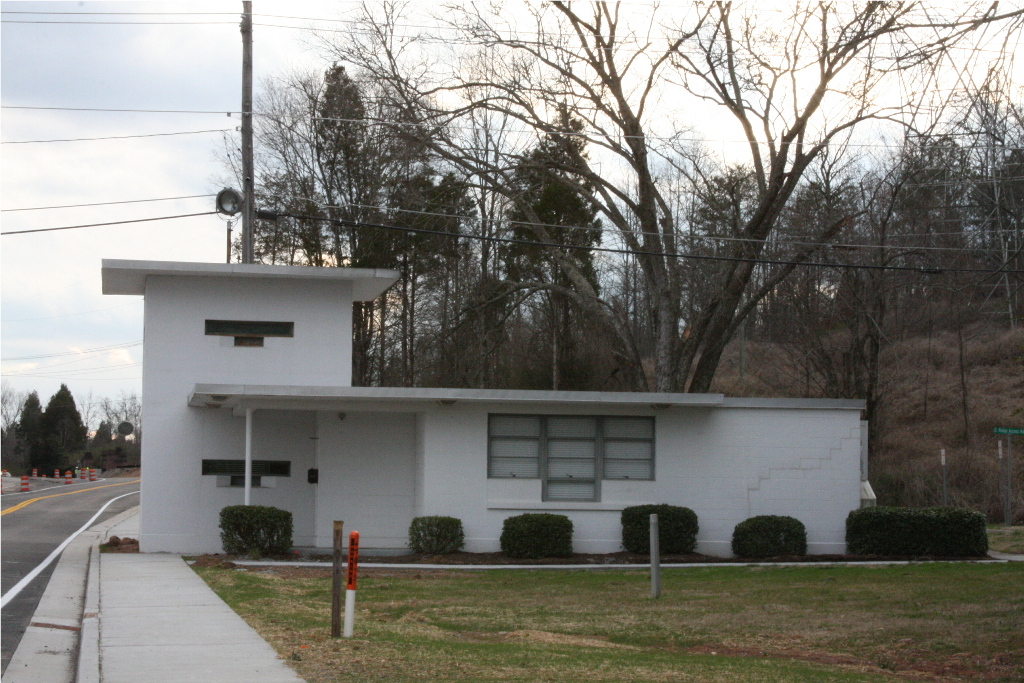
These Cold-War era gate houses are still there and are just as impressive as ever. This particular one has administrative space included, which was used, among other things, to issue passes to plant visitors. In the 1990s we used it as a conference room, a place convenient to meeting participants from different locations.


But it had to be intimidating in its time, with the gun ports on all sides.


The road that passes through this gate is now a public highway, and serves as the city's access to the south and west. It's also undergoing much-needed widening to four lanes. But the guard gates remain and will continue to remain, as the history of the Manhattan Project and Oak Ridge is at last being preserved and promoted.

Thursday, March 1, 2012

Thomas Hughes Public Library

Thomas Hughes's vision for his utopian settlement on the Tennessee Cumberland Plateau was for a class-free society that combined hard work with cultural pursuits. One manifestation of that vision was the Hughes Library.

It opened on October 5, 1882, two years to the day after Hughes dedicated the Rugby settlement. Being a prominent figure, as well as a best-selling author, publishers quickly filled the building with more than 7,000 volumes of the latest Victorian works.

It operated as a circulating library for more than 60 years. It contains more than 7,000 volumes, and none that was printed after 1899! One can only imagine the world view gotten by the students from the next-door Rugby school by reading only 50-plus-year-old books, especially since electricity, and thus television, didn't come to this part of the Plateau until the early 1950s.

The biggest change one notices today from the 1940s photo above is what's hanging on the ends of the bookcases. Thanks to detailed records, even the books on the shelves are in the same location they would have been in during the 1880s. However, the volumes no longer circulate and, although available to scholars, must be handled with cotton-gloved hands.

We've been told by visitors that the building itself is the best example of English-Victorian architecture to be found in Rugby. I can't vouch for that, but it is picturesque.