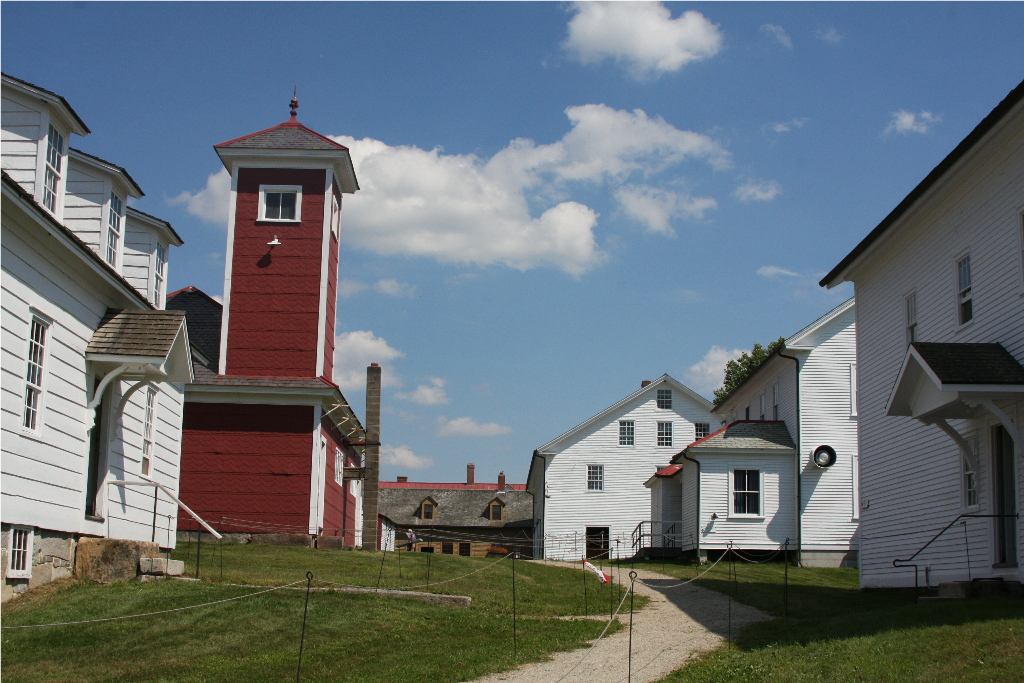
One's first reaction on arriving at the last active Shaker Village is "It's so small!" It's barely bigger than a lot of family farms, if that. But it's home to the last practicing members of the United Society; five Shakers and two novitiates. They conduct services in their 1794 Moses Johnson meeting house every Sunday in summer, and continue to welcome the world to their services. Winter services are held in a chapel in the dwelling across the road. According to our tour guide, services no longer include the dances and marches so long associated with Shakers, but consist of songs, readings from the Bible, and reactions to the readings and testimonials.
As you enter the parking lot you are greeted with a sign in front of what you later learn is the herb house that proclaims "PRIVATE beyond this point. Car Exit Only." Being the home of the remaining Shakers, there are few places the visitor can go without a tour guide. Our tour guide did an excellent job, however, and we did get to see several of the buildings.
The tour starts in the Boy's Shop, where young boys were taught trades. There are museum exhibits here as well. But again, no interior photos were allowed. There are more museum exhibits in the Spin Shop next door.
The tour took us into the meeting house, which looks nearly the same as the Hancock meeting house, plus we got to see the second floor living quarters that the ministry once occupied. It is furnished with appropriate Shaker antiques, but no photography was allowed. Our tour guide reminded me of that fact frequently, since I still had my camera with me. On the return walk we got to visit the sisters' shop while there was a lull in the day's work there.
The sisters' shop is home to the village's herb industry and the smells were delightful.
After the short tour I wandered around outside the quarantine area, first to the barns. They certainly say "Maine'" don't they?
From there I walked up to the road to get a shot of the dwelling. Always the smallest of the Shaker communities, it reached a peak of around 200 shortly after its founding in 1783. That number had dwindled to around 150 during the time before the Civil War when the Shaker movement was at its height. From that point there has been a steady decline, as in other Shaker communities.
Our visit concluded at the Trustees' Office, which today still operates a store. Here my wife bought a few "stocking stuffers" for Christmas, plus a couple of items for our granddaughter that won't wait until Christmas.
I can imagine the stresses to residents of having their home open to tourists, and the need to exercise control over movement on the site. The tour guides are volunteers, not Shakers, and the two we encountered were knowledgeable and courteous. One was borderline paranoid about the possibility of pictures being taken inside buildings. Since I don't agree with that policy, and photographs are a large part of my reason for visiting in the first place, I found that annoying. Perhaps she had just recently been taken to the whipping shed for not being diligent.
Showing posts with label Shakers. Show all posts
Monday, September 24, 2012
Thursday, September 20, 2012
Canterbury Shaker Village
The Canterbury, New Hampshire, Shaker village extends a warm welcome at first sight. Still rural, it is unique among Shaker museums in that it passed directly from the Shakers to the non-profit museum corporation. In fact, the last sisters remained here as the museum developed and their lodging was the last building to be incorporated into the museum. By not experiencing a period of private ownership, the village remains more intact than any other Shaker site, except for Sabbathday Lake, which remains an active community.
The first thing a person familiar with Shaker sites notices is the density of buildings. We know from old maps of other villages that they have lost many buildings to fire and demolition over time. Here at Canterbury, the Church Family site retains the density of a functioning Shaker community. Moreover, the buildings date from throughout its history, giving a feel for how life changed there over time and how technology impacted the people's lives.
Shaker life was all about the church, so the meeting house was of primary importance. The community was founded in 1792 and their Moses Johnson-built meeting house was completed the same year. The church family dwelling wasn't begun until the following year.
The initial building was small, but grew through many additions to where it could house up to 100 members. The bell tower, or cupola, was added in 1832 and met with opposition from the central ministry at New Lebanon.
According to their web site, the tower was shortened by 5 feet 5 inches in response. Mentally adding back that height, one can understand why the central ministry might not be pleased. Shakers were still strict about not making a show of things at that time.
The Enfield House was built in 1826 as the trustees office for the Canterbury Second Family. In 1921 the Shakers moved it to the Church Family where it housed the sisters who left the Enfield community as it was being closed in 1923. It became the preferred dwelling in the 20th century because it was more modern than the Church Family dwelling.
Like Enfield, the Canterbury museum does not permit photography inside the buildings. So interior shots are few and caught in unsupervised moments (I'll have a rant on this subject in a few days). Pity, for there is a lot to see here.
One of the outstanding features of the Church Family is this unique oven. There are four doors opening on revolving shelves each four feet in diameter. There is some sense of scale from the bricks, but consider that 60 loaves of bread could be baked simultaneously. The oven was designed by a Shaker sister and completed in 1878.
Tomorrow I'll take you to some of the dependent buildings and we'll investigate life at the Canterbury village.
The first thing a person familiar with Shaker sites notices is the density of buildings. We know from old maps of other villages that they have lost many buildings to fire and demolition over time. Here at Canterbury, the Church Family site retains the density of a functioning Shaker community. Moreover, the buildings date from throughout its history, giving a feel for how life changed there over time and how technology impacted the people's lives.
Shaker life was all about the church, so the meeting house was of primary importance. The community was founded in 1792 and their Moses Johnson-built meeting house was completed the same year. The church family dwelling wasn't begun until the following year.
The initial building was small, but grew through many additions to where it could house up to 100 members. The bell tower, or cupola, was added in 1832 and met with opposition from the central ministry at New Lebanon.
According to their web site, the tower was shortened by 5 feet 5 inches in response. Mentally adding back that height, one can understand why the central ministry might not be pleased. Shakers were still strict about not making a show of things at that time.
The Enfield House was built in 1826 as the trustees office for the Canterbury Second Family. In 1921 the Shakers moved it to the Church Family where it housed the sisters who left the Enfield community as it was being closed in 1923. It became the preferred dwelling in the 20th century because it was more modern than the Church Family dwelling.
Like Enfield, the Canterbury museum does not permit photography inside the buildings. So interior shots are few and caught in unsupervised moments (I'll have a rant on this subject in a few days). Pity, for there is a lot to see here.
One of the outstanding features of the Church Family is this unique oven. There are four doors opening on revolving shelves each four feet in diameter. There is some sense of scale from the bricks, but consider that 60 loaves of bread could be baked simultaneously. The oven was designed by a Shaker sister and completed in 1878.
Tomorrow I'll take you to some of the dependent buildings and we'll investigate life at the Canterbury village.
Labels:
Canterbury Shaker Village,
Moses Johnson,
Shakers
Tuesday, September 18, 2012
Shaker Cottage Industry
Shakers' needs were no different from those of any rural population in the late 18th and early 19th centuries. Not yet having access to cheap, mass-produced goods, the communities had to produce most of what they needed, from food to clothing to furniture. But unlike the world's people, they had many hands to do the work and could enjoy certain economies of scale. This first photo shows a tailor shop with wooden patterns and cutting counters. With up to 300 members at Hancock, there was always a demand for garments from women's dresses and shawls to men's shirts and trousers. The Shaker cloak became an item sought by the world's people and grew to be a source of needed cash for the communities.
Shaker oval boxes and carriers were used for a wide range storage and transport. They were not unique in concept, but their superiority in design and workmanship made them much sought after. They were produced in the thousands and today are symbols of Shaker life and quality. Reproductions are widely sold.
The Shaker chair was a refined version of common chairs of the time. Their unique combination of strength and lightness have made them classics. Many communities had their chair shops and sold their excess production, although it was Mt. Lebanon alone that developed a truly commercial enterprise. And experts can determine which community made a chair by the slight differences between them. The brethren made the frames and the sisters wove the cotton tapes most commonly used in the seats and sometimes in the backs of chairs. Weaving the tapes into the seats could have been done by men or women.
Turning the wood to produce the rounded posts, stretchers, and finials was often on a treadle lathe. The brother turning the wood also produced the power that turned it. Eventually Hancock developed a water-powered mill that we'll see shortly.
Now here's an item I wish I had. It's a chair vise. It clamps the chair and holds it at working height. The base swivels to allow the chair to be turned continuously as you proceed with weaving strips first into the top side and then the bottom and back again. Since I have six dining chairs to reseat this winter, this device could really speed up the job.
Here's an example of Shaker ingenuity and invention. The brothers, like men everywhere, had a habit of leaning back in their chairs. That not only made dents in wood floors, but also sometimes ended with the brother falling over backwards. These tilters built into the bottoms of the back legs give continuous full contact with the floor when the sitter leans back, which both protects the floor and provides increased stability.
I mentioned the water-powered mil. Here beneath its floor is the turbine that replaced the original waterwheel.
That power was transferred by belts and shafts to run all sorts of woodworking tools. It also powered washing machines housed in the laundry, elsewhere in the building.
Being a communal society, the Shakers had what was in effect a commercial laundry. The sisters rotated job assignments each month so everyone shared both the good and the bad jobs throughout the village. Here in one room of the laundry are tables for folding clothes and racks for drying them. The large stove in the center of the room was designed to heat the flat irons they used.
With that huge stove in the room, I don't know why they needed this one, but it does illustrate Shaker innovation. There is a stove in the top photo of the tailor shop that represents the basic Shaker stove. It consists of a firebox connected to a stovepipe. A superheater has been added to the one above. The purpose of the superheater is to simply slow down the escape of hot gases from the firebox to allow more heat to escape into the room. And they do just that.
And finally, there was production of fabric. Wool, cotton, and linen all were spun into yarn and woven into fabric. The Pleasant Hill Shakers in Kentucky had a silk worm industry, as well, and shipped silk and silk fabric to other communities. I'm not aware of Shakers ever selling fabric to the world, but they did sell finished goods, from linens to garments. But the major part of their output was clothing for their own community.
After the Civil War when manufacturing took off in this country, the Shakers could buy bolts of cloth cheaper than they could make it. They lamented the inferior quality of the fabric they bought, but with shrinking membership had little choice but to buy instead of make.
Shaker oval boxes and carriers were used for a wide range storage and transport. They were not unique in concept, but their superiority in design and workmanship made them much sought after. They were produced in the thousands and today are symbols of Shaker life and quality. Reproductions are widely sold.
The Shaker chair was a refined version of common chairs of the time. Their unique combination of strength and lightness have made them classics. Many communities had their chair shops and sold their excess production, although it was Mt. Lebanon alone that developed a truly commercial enterprise. And experts can determine which community made a chair by the slight differences between them. The brethren made the frames and the sisters wove the cotton tapes most commonly used in the seats and sometimes in the backs of chairs. Weaving the tapes into the seats could have been done by men or women.
Turning the wood to produce the rounded posts, stretchers, and finials was often on a treadle lathe. The brother turning the wood also produced the power that turned it. Eventually Hancock developed a water-powered mill that we'll see shortly.
Now here's an item I wish I had. It's a chair vise. It clamps the chair and holds it at working height. The base swivels to allow the chair to be turned continuously as you proceed with weaving strips first into the top side and then the bottom and back again. Since I have six dining chairs to reseat this winter, this device could really speed up the job.
Here's an example of Shaker ingenuity and invention. The brothers, like men everywhere, had a habit of leaning back in their chairs. That not only made dents in wood floors, but also sometimes ended with the brother falling over backwards. These tilters built into the bottoms of the back legs give continuous full contact with the floor when the sitter leans back, which both protects the floor and provides increased stability.
I mentioned the water-powered mil. Here beneath its floor is the turbine that replaced the original waterwheel.
That power was transferred by belts and shafts to run all sorts of woodworking tools. It also powered washing machines housed in the laundry, elsewhere in the building.
Being a communal society, the Shakers had what was in effect a commercial laundry. The sisters rotated job assignments each month so everyone shared both the good and the bad jobs throughout the village. Here in one room of the laundry are tables for folding clothes and racks for drying them. The large stove in the center of the room was designed to heat the flat irons they used.
With that huge stove in the room, I don't know why they needed this one, but it does illustrate Shaker innovation. There is a stove in the top photo of the tailor shop that represents the basic Shaker stove. It consists of a firebox connected to a stovepipe. A superheater has been added to the one above. The purpose of the superheater is to simply slow down the escape of hot gases from the firebox to allow more heat to escape into the room. And they do just that.
And finally, there was production of fabric. Wool, cotton, and linen all were spun into yarn and woven into fabric. The Pleasant Hill Shakers in Kentucky had a silk worm industry, as well, and shipped silk and silk fabric to other communities. I'm not aware of Shakers ever selling fabric to the world, but they did sell finished goods, from linens to garments. But the major part of their output was clothing for their own community.
After the Civil War when manufacturing took off in this country, the Shakers could buy bolts of cloth cheaper than they could make it. They lamented the inferior quality of the fabric they bought, but with shrinking membership had little choice but to buy instead of make.
Tuesday, September 11, 2012
Meet some Mt. Lebanon Shakers
This poster from Mt. Lebanon has some of the most important members who lived there, but lacks two who were perhaps the most important of all. Joseph Meacham moved to Mt. Lebanon soon after assuming leadership of the Society. Meacham was a former Baptist minister whose ideas transformed the Shakers. Naming Sister Lucy Wright as eldress and female head of the Society, he set the Shakers on a course that would lead to full equality between the sexes. There are no images of either since they both died before photography was invented in 1826. Together they called the converts together into communities, established the governing structure for those communities, established communal ownership of all property, dissolved marriages of converts and placed children together under the supervision of unrelated adults. These changes were referred to as being in "church order."
Lucy Wright initially had resisted joining the Shakers. Her husband, Elizur Goodrich first joined the Shakers after attending a revival in 1780. Lucy clung to her marriage vows for several months before giving in. When Joseph Meacham left Watervliet for New Lebanon, he called Lucy to join him, naming her an eldress and co-leader of the Society. He also gave her the title of Mother, which previously had been bestowed only on Ann Lee. Meacham and Wright served as the leaders and administrators of all Shaker families in every Shaker community, naming an elder and eldress to administer each community, with subordinate elders and eldresses over each family within a community. Thus the duality of joint male/female leadership was implemented at every level with the Society.
Lucy Wright continued to be the female leader of the Society following Meacham's death in 1796. It was she who sent the three missionaries (Issachar Bates, John Meacham, and Benjamin Seth Youngs) from New Lebanon to the western frontier following the Cane Ridge Revival. She began a publishing enterprise that facilitated standardization of Shaker faith and practice across the communities. Wright returned to Watervliet, where she died in 1821. She is buried next to Ann Lee.
Robert Wagan didn't create the Shaker chair, but he introduced mass-production techniques that standardized parts and increased production. The chair industry at Mt. Lebanon became a major source of income for the community with chairs being shipped all over the world. The number of models and styles was staggering; rockers in seven sizes with multiple styles and materials, ladder-back straight chairs, woven-back straight chairs, chairs with and without arms. For a while, chairs carried the label "Robert Wagan & Co., Mt. Lebanon, New York." Straight chairs that sold new for $ 0.50 each now sell for thousands of dollars.
Anna White was eldress in the Mt. Lebanon North Family. It is usually her photograph that will appear if you seek an on-line image of Ann Lee.
Lucy Wright initially had resisted joining the Shakers. Her husband, Elizur Goodrich first joined the Shakers after attending a revival in 1780. Lucy clung to her marriage vows for several months before giving in. When Joseph Meacham left Watervliet for New Lebanon, he called Lucy to join him, naming her an eldress and co-leader of the Society. He also gave her the title of Mother, which previously had been bestowed only on Ann Lee. Meacham and Wright served as the leaders and administrators of all Shaker families in every Shaker community, naming an elder and eldress to administer each community, with subordinate elders and eldresses over each family within a community. Thus the duality of joint male/female leadership was implemented at every level with the Society.
Lucy Wright continued to be the female leader of the Society following Meacham's death in 1796. It was she who sent the three missionaries (Issachar Bates, John Meacham, and Benjamin Seth Youngs) from New Lebanon to the western frontier following the Cane Ridge Revival. She began a publishing enterprise that facilitated standardization of Shaker faith and practice across the communities. Wright returned to Watervliet, where she died in 1821. She is buried next to Ann Lee.
Robert Wagan didn't create the Shaker chair, but he introduced mass-production techniques that standardized parts and increased production. The chair industry at Mt. Lebanon became a major source of income for the community with chairs being shipped all over the world. The number of models and styles was staggering; rockers in seven sizes with multiple styles and materials, ladder-back straight chairs, woven-back straight chairs, chairs with and without arms. For a while, chairs carried the label "Robert Wagan & Co., Mt. Lebanon, New York." Straight chairs that sold new for $ 0.50 each now sell for thousands of dollars.
Anna White was eldress in the Mt. Lebanon North Family. It is usually her photograph that will appear if you seek an on-line image of Ann Lee.
Frederick W. Evans became well known through granting interviews, correspondence, and his autobiography. He corresponded with a wide range of important figures, including President Lincoln, whom he contacted to try to obtain pensions for Shakers who had served in wars before joining the Society. His Autobiography of a Shaker and Revelation of the Apocalypse was a major contribution to Shaker apologetics.
Wednesday, September 5, 2012
Ann, the Word
In the beginning was the Word,
and the Word was with God,
and the Word was God. (John 1:1)
John in his gospel sets out immediately to establish the divinity of Jesus of Nazareth by using the Greek term "Logos" or "Word." Ann Lee (1736-1784), the founder of the religious sect that became known as Shakers, was known to refer to herself as "Ann, the Word," a clear reference to her belief that she was The Christ in female form. If that were true, then her presence was the Second Coming that Jesus had promised. Thus her followers went by the formal name of The United Society of Believers in Christ's Second Appearing.
She was born in Manchester, England, to a blacksmith father who forced her into a marriage she did not want. This union produced four still births and four living children, none of whom survived beyond age six. Immersing herself in religion, she rose to leadership in a small group of Quakers who had become charismatics. Ann advocated the dissolution of marriage and a life of celibacy, teaching that sexual relations were sinful and that one must strive for perfection in all areas.
Little remains of this first Shaker community, and what does remain is mostly corrupted. Much of the village named Niskayuna or Watervliet now lies within the boundaries of the Albany airport and has been removed. The meeting house, above, is the best remaining example of Shaker architecture and serves as the museum building for the nonprofit corporation that interprets the site.
Other buildings, such as the brethren's shop, have been extensively modified and used for other purposes. The main reason to visit Watervliet today is the cemetery, where Mother Ann and the other first-generation leaders are buried.
Ann died in 1784 at age 48, probably from lingering effects of a beating received during a missionary trip the previous year. She was succeeded by James Whitaker as leader of the Shakers, and on his death three years later Joseph Meacham assumed leadership, along with Eldress Lucy Wright. Meacham and Wright called the believers into "church order," establishing dual leadership by both males and females, bringing them together into communities, organizing them into families, and establishing many of the rules that would both guide and define the Shakers.
Among the changes that evolved were replacing the unorganized ecstasy of Shaker worship with choreographed dances and marches, a large body of songs replacing the wordless (la-la-la) tunes previously used, communal ownership of property, equality of sexes and races, and simple, easily understood guidance based on Mother Ann's teachings (e.g., "Put your hands to work and your hearts to God").
The culture that developed in Shaker communities produced results that have made the Shakers well-known and respected today, although the Society itself is nearly extinct. Communal life and celibacy eased many of the burdens that face most humans. Shakers had time to consider better ways of doing jobs. That free time and their stress on perfection led to many labor-saving and more efficient inventions, such as the flat broom and the circular saw blade. Mother Ann's admonition to "build as if it has to last a thousand years" has left us with many outstanding examples of Shaker architecture. Their insistence on simplicity and functionality produced starkly beautiful furniture and artifacts that are highly prized by collectors today.
Over the next couple of weeks I'll point out examples of some of these developments while visiting the New England Shaker sites that are accessible to the public. And I will introduce you to some other Shakers of historical importance. Please join me.
Labels:
Ann Lee,
Mother Ann,
Shakers,
Watervliet Shaker Community
Subscribe to:
Posts (Atom)